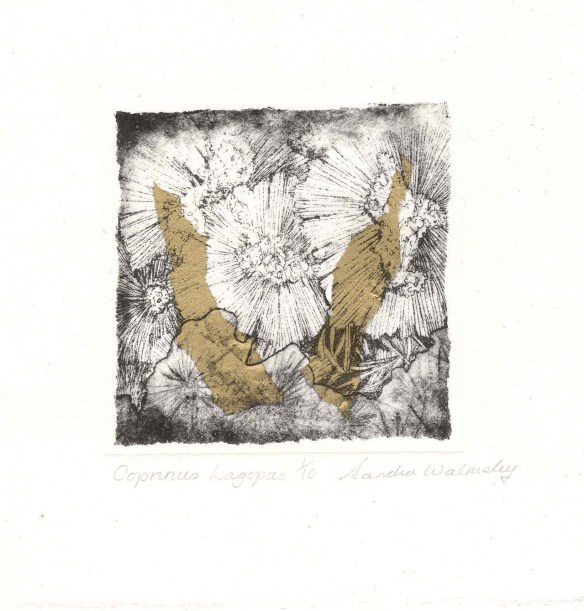
I found a copy of my mini-print of the fungus. Here it is

I found a copy of my mini-print of the fungus. Here it is
It has been pointed out to me that not everyone will know that Yorkshire Fog is a grass…I have not suddenly transported to Yorkshire.
25/06/14
At the weekend I was chatting to farmer about the grass this year. The extra warmth, lack of a cold winter and lots of spring rain mean that grasses and cereal crops are early and prolific. On our morning walk the Yorkshire fog reaches up to my thighs. I wear wellies and rain jacket on wet mornings but the bit between the two gets soaked. One day I will remember to wear a longer coat when it has been raining.
On the clear-fell area I realise there are foxgloves flowering but they are drowned in the mauve sea of the Yorkshire Fog. Having had their earlier setback, whatever it was , the flowers are shorter than they would normally be.
The Climbing Corydalis continues on its creeping path trying to climb- is it looking for the trees that were felled ? It is crawling across the furrows where the young saplings are growing. Perhaps it is establishing its rights while the trees are still young. I think the tracks were sprayed with weedkiller earlier in the year. I have read research that suggests protecting young pines from weeds helps them to be more resilient to Red Needle Blight.
We met two people on the clear-fell area a few days ago. They had a camera and a book and were peering on the ground. “What are you looking for?” I asked. “A rare Breckland flower” the woman told me. “Which one?” “Tower Mustard” “I didn’t realise it was rare” I said. “There are lots over there” I pointed. She smiled but carried on where she was walking. I realise why when we turn on to the path I had indicated. The Tower Mustard have been almost smothered by grass and vicious thistles. Certainly not suitable for photographs. I’m glad I found out it was rare. I was thinking of picking one and taking it home to draw earlier in the year.
There is a swathe of tall umbellifers growing alongside the same path. They are over two metres tall in places and have feathered leaves, purple spotted stems and effervescent froths of white flowers. This is one of my favourite spots in the forest. I take a flower and leaf to identify it. When I get home I realise it may be Hemlock. What a way to die for poor old Socrates; a poison made from such a lovely flower. The book says it is “highly poisonous…and an unpleasant smell when bruised.” It does smell awful. I had no idea it was Hemlock. When I think about it, the vision I had in my mind of Hemlock was actually some sort of Artemesia. It seems Plato invented his idea of a sort of heaven to reassure Socrates’ students that his death wasn’t final. The Hemlocks die in the Autumn and dry almost white. A sea of ghosts in the winter.
18th June 2014.
I was woken this morning by the din of rooks. Last year they lived in the willow tree at the end of the road. During the winter they moved to the sycamore tree in our next door neighbour’s garden. I enjoyed the striking image of black scruffy shapes against bare branches and twigs. Now they have moved to the trees at the bottom of our garden. They are the noisiest birds imaginable and they drown out the melodious dawn chorus we have been used to.
The old collective noun for rooks is a “Parliament.” It is perfect. They create a cacophony of sound, a harsher more abrasive version of prime minister’s question time. They are probably trading insults and trying to outshout each other. There seems to be no semblance of discussion, only a constant squawking which could be the rook version of “Hear! Hear!” nor is there any evidence of a Speaker rook calling them to order.
Meanwhile it is costing us a fortune in corn for the chickens, and seeds and suet pellets for the other garden birds. The rooks have worked out they have a good billet here tucking in to all this food we provide.
I was worry they would attack our other bird visitors, or at least their eggs or chicks, so I look it up on line. There seems to be no evidence that they do attack, although they eat road-kill and have pretty eclectic food tastes. Of course- once I start searching there is no end of fascinating information to distract me from what I should be doing.
The British Garden Birds website tells me “Rooks are rarely alone and so their raucous caws can become overwhelming.” That’s another thing about the internet, you can always find out things you already know. I did know they are intelligent birds, but it seems that in laboratories they even learn to fashion tools. The BBC Wildlife website reports that one learned to twist a piece of wire into a hook to fish for a can of food. The website points out that this has not been known in the wild. The scientist, aptly called Mr Bird, speculates why this should be the case. I question why on earth would they need to do this in the wild? On the other hand they may just do it in the privacy of their own homes or in cages they may just do it to entertain their human guards.
The BBC also informs me that they are unpopular with farmers because of their omnivorous diet and “in spite of their reputation for intelligence, they can’t tell the difference between discarded turnips, those the farmer has put out for sheep, and those he wishes to sell.”
I feel guilty but I look up “How to get rid of rooks humanely”. Basically there isn’t a way apart from shotgun fire and that might scare off the other birds which we have spent the last twenty years courting. When the shooting season starts there will be shoots across the field at the bottom of the garden. Pheasants seem to come into our garden then as a safe haven, a gun free zone, but it is possible the guns will scare off the rooks.
A few weeks ago we had a village Fayre and there was a scarecrow competition. Perhaps my neighbour still has the one she made so that I could borrow it. I think I will probably have to resign myself to closed windows and ear plugs and look forward to the dawn getting later after Saturday.
6/6/14
Sunshine was forecast and it has arrived. Jeffrey is going to the opticians so I am walking the dogs on my own. I grab a pair of binoculars and Charlie and I go to collect Jazzer. There is little breeze and I stroll listening to the birds. It’s hardly the dawn chorus, I rarely see dawn, but the forest is still in the sunshine and bird songs float among the trees.
I see movement at the top of a pine tree where I saw the . The bird hops about in the branches, doing a good impersonation of a pine cone when I try to focus on it. When I eventually succeed it turns out to be a chaffinch;a disappointment. I sit for a hwile on a piece of tree trunk which the Forestry have left in the middle of a track for no apparent reason. I am hoping to spot woodlarks. I can hear them but no joy in spotting them.
Jazzer and Charlie carry on without me for a while then come back and hassle me when they realise they are unaccompanied, so we carry on through Meg’s track. The wild privet have started to flower and there is a slight fragrance but there aren’t enough blooms yet to produce the heady scent that I love and associate with summer.
I hear a goldcrest where I often hear it. A rook flies overhead. There are not many flowers on the sides of the drove at present. The cow parsley is past its best. There are one or two Bladder Campion reminding me that I have one in a vase waiting to be drawn. I have the same guilty feeling about the Ribbed Plantain. They are not the most showy plants with brown, bee like flowers but the textures are fascinating.
I wonder whether we are going to have another mast autumn. Everything is early. The hawthorne are smothered with the pink bloom of berries forming. The beech look strange. They have their mast forming like small green teasels along all the outlying branches. There are bunches of sycamore seeds hanging like propellers. They are all far more advanced than you would expect them to be. I haven’t noticed any acorns. I need to look more closely to see what is happening with them.
2/6/14
I am deeply disappointed in the clearfell area. I had been looking forward to a spectacular show of foxgloves. There were so many plants throughout the autumn and winter. Then there was what I can only assume was a late frost and as I walked across the field all I could see were clusters of brown crinkled clumps where the green furry whorls of leaves had been. The devastation was so focussed that at first I thought it must have been weed killer but why would anyone spray just the foxgloves? Everything else seemed unscathed.
Breckland has an unusual climate and frosts have been recorded in August although I haven’t experienced that. An open field can often attract a much sharper frost than the surrounding land but why only the foxgloves? The Climbing Corydalis escaped unscathed and now they are scrambling about carpeting the ground with their delicate red straggling stems, frothy leaves and palest green clusters of tiny pea flowers. Why would they not succumb to the frost when the foxgloves did?
I was relieved when the foxgloves started to recover. Plants are resilient. Green shoots pushed their way through the crumpled brown and flowers have started to appear. They are smaller and later than they would have been but the urge to reproduce isn’t easily defeated. These foxgloves lay dormant for decades while pine trees grew over them then emerged after the trees were harvested three years ago.
I don’t understand why they put on such a poor show last year compared to the year before either. I know they are biennial but there must have been some seeds in the soil which could have come up without having to wait for a new batch to be produced. The same thing happened with the Verbascum. They didn’t flower last year. They should produce blooms this summer. There are lots of rosettes of their silky silver leaves emerging if they can manage to fight their way through the vicious thistles that are thrusting through the grass everywhere.
At least the thistles provide food for the Goldfinches. I saw a flock of them feeding on these patches of thistles last autumn. It seems the number of Goldfinches has increased , unlike other birds. I think it is because people are feeding them sunflower and niger seeds. They consume about five kilos a week from our bird feeders.
The grasses are shimmering purple and yellow and every shade of green but they remain a mystery to me. My attempts at grass recognition have been unsuccessful. I cannot find a book which has photographs or even coloured pictures. I know I should be approaching them the proper botanical way with a key but the birds are challenging enough for me at present so I am just enjoying the grass effects.
 sandra walmsley