Unknown's avatar

About sandrawalmsley

Working hard at being a writer. Reinventing myself again after successful career in social services and health. Haven't given up on the artistic stuff but trying to combine it with writing to carry on with my hope to make at least a little bit of the world better.

Turtle dove.

13th July.
A major problem with birds is that they won’t sit still. Just when you catch sight of one it flies away or hops about and pops behind a bunch of leaves while you try and focus your binoculars. I have set myself a new goal this year; to learn more about birds. Pursuing this latest nature quest I draw up in the car park of Lackford Lakes Nature Reserve and sit in my car waiting to hear an interview with Natalie Bennett against TTIP. A grey haired, suntanned man wearing a baseball cap rushes over. “ If you get out quickly we have a turtle dove in the ‘scope over there.” I can’t resist an invitation like that. Natalie can’t compete. After all I probably know what she had to say. I have been signing petitions against TTIP for some time.
The Turtle Dove is as beautiful as I could expect. Scaled brown and black wings, pink breast shading into bronze, black and white stripes across its neck, it sits preening itself on top of a dead tree. The precarious lives these birds live makes them rare now. Huge numbers are shot as they hazard the hunters of Cyprus and winter south of the Congo. Here sits a handsome male in Suffolk. I think of Passenger Pigeons which the settlers in America shot to extinction. There is a stuffed one in the museum at Norwich which I spent some time drawing for my final degree show. I hope Chris Packham’s campaign manages to save the Turtle Dove from the same fate. The bird takes off.
I join the anorak clad binocular laden attendees dribbling into the education room. Many of the group of nine know each other. The tanned man is Paul, our guide. While we enjoy our welcome cup of tea and bourbon biscuit he points out of the window. On a pale, dead branch emerging from a reed lined pond sits a kingfisher. Canoeing on the Dordogne one year , their jewel colours flashed as they skimming the surface but I have never been able to see one in Britain.
At exactly ten o’clock, Paul starts by explaining about bird moulting. Feathers are minor engineering miracles. When birds preen they are zipping up the rows of tiny hooks . They have to moult because feathers wear out but their diverse strategies are complicated. Species moult at different times and in different ways which makes bird identification even harder.
A week ago a small brown bird with a spotted breast landed on a garden chair below the bird feeder in my garden. I was puzzled. It looked like a robin but had no red breast. When I looked it up, the book said it was a juvenile robin. The next time I saw it the breast was turning orange and the speckles were disappearing. I recounted this to Paul who nodded sagely and said “Yes, it only takes them about three weeks to change. The adults are conditioned to attack everything with a red breast so the speckled plumage protects the juveniles.” I know robins are fiercely territorial. That is one of the reasons it is so easy to get to know individuals in our gardens. They might be less friendly if we wore red teeshirts.
The new feathers push out the old ones as they wear out. Swans, geese, ducks and rails shed so many feathers at the same time that they cannot fly. They lurk in groups at the edge of lakes, ready to dash into the greenery to hide if they have to avoid predators. Raptors take a different approach. They have to carry on flying to catch their food, so they lose their primary feathers symmetrically. You can’t have a wobbly hawk trying to swoop down on its dinner.
The Turtle Dove flies back and forth as we listen, distracting us from Paul’s descriptions of the intricacies of moulting. The more I hear, the more complex it sounds. Bewildered, I feebly voice my concerns “How I will ever know enough?” Paul smiles, his bronze face wrinkling “Just constant practice, that’s the only way to do it…there’s no substitute for looking acutely.” Gilbert White would have been proud of him.
We set off along the tracks into the reserve. The loud purring of the Turtle Dove follows us. Even if I see nothing else I’m happy. I have seen a Kingfisher and a Turtle Dove.

Morning walk

2/7/14

A warm bright morning with the softest breeze. There is nothing to hurry for so I enjoy strolling along the morning walk. Charlie and Jazz are happy to mooch along enjoying smells.

I take the short cut across the field. That way I am nearer to the trees so there’s a chance of seeing birds and there is shorter grass where I can see what is growing. I  was leafing through my flower guide yesterday when I  found a page of  Forget- me- nots . I had assumed the ones here are just garden escapees but now I know they are not   I decide I need to identify them while there are enough flowers left at the top of the long stems of seeds. I pick one to take home. I don’t think there is any danger that they are rare.

There are patches of yellow toadflax, dotted with orange in the shorter grass. Small groups of Self Heal remind me of pirouetting bumble bees with purple tutus. There are still some vivid blue Wood Speedwell nestling along  this stretch too.

 Walking  this way I look along the furrows of planted pine seedlings. Despite the weedkiller spray earlier in the year , there is little evidence of trees below the vegetation. Where the spray killed all the weeds at the time new ones have sprung up. Walking earlier in the year I thought  “ they look like Groundsel but not quite the same ” when I looked them up they turned out to be Heath Groundsel, a taller, paler version of the yellow weed  in my garden. They are unattractive straggly plants with clusters of tiny yellow brush flowers but en masse between strips of mauve Yorkshire fog the overall striped effect in the morning sun is a delight.

I notice that the Mahonia shrublings alongside the track are starting to sport bunches of berries ripening. When I turn the corner onto Meg’s track I am greeted by a glorious patch of them. Some leaves are different shades of green but many are red and orange. This group gets  lot of sun and there are stringed bunches of dusty  blue fruits hanging in contrast against the spiked leaves. I stop and look for a while trying to tease out all the colours until I realise I have no dogs with me. I walk on a find Charlie and Jazz have come to look for me. As soon as they realise I am there they turn round and go off on their own explorations again.

As I walk along the drove the bracken are crowding to the edge pushing away less vigorous  plants. I find a couple of raspberries which I pick and eat. Vipers Bugloss are stretching out their startling blue spikes and Ribbed Mellilot are straggling across the with their tufts of yellow pea flowers. My book says they are  “possibly native in Southern England and Wales but introduced elsewhere”. According to the little map shaded pink in the book they are counting eastern England as South so I assume these are not introduced.

There are scores of butterflies stuttering across the tops of the grasses and bracken.  I think I see some Meadow Browns with a dash of orange on their open wings, dancing among the numerous brown Ringlets. When I get back to the car there is a Greater knapweed in flower close by. I count five Ringlets sitting clustered on top of the purple flowers and a small tortoiseshell. They  seem sociable and are patient of my peering at them.

The Goldcrest sings as I walk along but it hides among the treetops as usual.

The Forget- me-not turns out to be a Changing Forget- me- not. The flowers change from yellowish to blue.


Forest walk

25/06/14

At the weekend I was chatting to farmer about the grass this year. The extra warmth, lack of a cold winter and lots of spring rain mean that grasses and cereal crops are early and prolific. On our morning walk the  Yorkshire fog reaches up to my thighs. I wear wellies and rain jacket on wet mornings but the bit between the two gets soaked. One day I will remember to wear a longer coat when it has been raining.

On the clear-fell area I realise there are foxgloves flowering  but they are drowned in the mauve sea of the Yorkshire Fog. Having had their earlier setback, whatever it was , the flowers are shorter than they would  normally be.

The Climbing Corydalis continues on its creeping path trying to climb- is it looking for the trees that were felled ? It is crawling across the furrows where the young saplings are growing. Perhaps it is establishing its rights while the trees  are still  young. I think the tracks were sprayed with weedkiller earlier in the year. I have read research  that suggests  protecting young pines from weeds helps them to be more resilient to Red Needle Blight.

We met two people  on the  clear-fell area a few days ago. They had a camera and a book and were peering on the ground. “What are you looking for?” I asked.  “A rare Breckland flower” the woman told me. “Which one?” “Tower Mustard” “I didn’t realise it was rare” I said. “There are lots over there” I pointed. She smiled but carried on where she was walking. I realise why when we turn on to the path I had indicated. The Tower Mustard  have been almost smothered by grass and vicious thistles. Certainly not suitable for photographs. I’m glad I found out it was rare. I was thinking of picking one and taking it home to draw earlier in the year.

There is a swathe of tall umbellifers growing alongside the  same path. They are over two metres tall in places and have feathered leaves, purple spotted stems  and effervescent froths of white flowers. This is one of my favourite spots in the forest. I take a flower and leaf to identify it. When I get home I realise it may be Hemlock. What a way to die for poor old Socrates; a poison made from such a lovely flower. The book says it is “highly poisonous…and an unpleasant smell when bruised.” It does smell awful. I had no idea it was Hemlock. When I think about it, the vision I had in my mind of Hemlock was actually some sort of Artemesia. It seems Plato invented his idea of a sort of heaven to reassure Socrates’ students that his death wasn’t final. The Hemlocks die in the Autumn and dry almost white. A sea of ghosts in the winter.


Aside

18th June 2014.

I was woken this morning by the din of rooks. Last year they lived in the willow tree at the end of the road. During the winter they moved to the sycamore tree in our next door neighbour’s garden. I enjoyed the striking image of black scruffy shapes against bare branches and twigs. Now they have moved to the trees at the bottom of our garden. They are the noisiest birds imaginable and they drown out the melodious dawn chorus we have been used to.

The old collective noun for rooks is a “Parliament.”  It is perfect. They create a cacophony of sound, a harsher more abrasive version of prime minister’s question time.  They are probably trading insults and trying to outshout each other. There seems to be no semblance of discussion, only a constant squawking which could be the rook version of “Hear! Hear!”  nor is there any evidence of a Speaker rook calling them to order.  

Meanwhile it is costing us a fortune in corn for the chickens, and seeds and suet pellets for the other garden birds. The rooks have worked out they have a good billet here tucking in to all this food we provide.

I was worry they would attack our other  bird visitors, or at least their eggs or chicks, so I look it up on line. There seems to be no evidence that they do attack, although they eat road-kill and have pretty eclectic food tastes. Of course- once I start searching there is no end of fascinating information to distract me from what I should be doing.

The British Garden Birds website tells me “Rooks are rarely alone and so their raucous caws can become overwhelming.”  That’s another thing about the internet, you can always find out things you already know. I did know they are intelligent birds, but it seems that in  laboratories they even learn to fashion tools. The BBC Wildlife website reports that one learned to twist a piece of wire into a hook to fish for a can of food. The website points out that this has not been known in the wild. The scientist, aptly called Mr Bird, speculates why this should be the case. I question why on earth would they need to do this in the wild? On the other hand they may just do it in the privacy of their own homes or in cages they may just do it to entertain their human guards.

The BBC also informs me that they are unpopular with farmers because of their omnivorous diet and “in spite of their reputation for intelligence, they can’t tell the difference between discarded turnips, those the farmer has put out for sheep, and those he wishes to sell.”

I feel guilty but I look up “How to get rid of rooks humanely”. Basically there isn’t a way apart from shotgun fire and that might scare off the other birds which  we have spent the last twenty years courting. When the shooting season starts there will be shoots  across the field at the bottom of the garden. Pheasants seem to come into our garden then as a safe haven, a gun free zone, but it is possible the guns will scare off the rooks.

A few weeks ago we had a village Fayre and there was a scarecrow competition. Perhaps my neighbour still has the one she made so that I could borrow it. I think I will probably have to resign myself to closed windows and ear plugs and look forward to the dawn getting later after Saturday.

Aside

6/6/14

Sunshine was forecast and it has arrived. Jeffrey is going to the opticians so I am walking the dogs on my own. I grab a pair of binoculars and Charlie and I go to collect Jazzer. There is little breeze and  I stroll listening to the birds. It’s hardly the dawn chorus, I rarely see dawn, but the forest is still in the sunshine and bird songs float among the trees.

I see movement at the top of a pine tree where I  saw the . The bird  hops about in the branches, doing a good impersonation of a pine cone when I try to focus on it. When I eventually succeed it turns out to be a chaffinch;a disappointment. I sit for a hwile on a piece of tree trunk which the Forestry have left in the middle of a track for no apparent reason. I am hoping to spot woodlarks. I can hear them but no joy in spotting them.

Jazzer and Charlie carry on without me for a while then come back and hassle me when they realise they are unaccompanied, so we carry on through Meg’s track. The wild privet have started to flower and there is a slight fragrance but there aren’t enough blooms yet to produce the heady scent that I love and associate with summer.

I hear a goldcrest where I often hear it. A rook flies overhead. There are not many flowers on the sides of the drove at present. The cow parsley is past its best. There are one or two Bladder Campion reminding me that I have one in a vase waiting  to be  drawn. I have the same guilty feeling about the Ribbed Plantain. They are not the most showy plants with brown, bee like  flowers but the textures are  fascinating.

  I wonder whether we are going to have another mast autumn. Everything is early. The hawthorne are smothered with the pink bloom of berries forming. The beech look strange. They have their mast forming  like  small green teasels along all the outlying branches. There are bunches of sycamore seeds hanging like propellers. They are all far more advanced than you would expect them to be. I haven’t noticed any acorns. I need to look more closely to see what is happening with them.

Forest walk

2/6/14

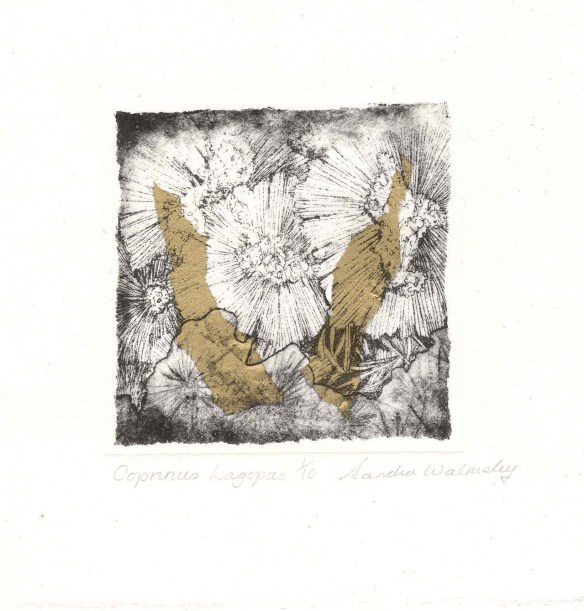
Despite my resolve to concentrate on birds and flowers this year I was diverted by another fungus. It is one I had previously done as an etching. It is a Coprinus lagopus or the Hare’s Foot Inkcap. I  suppose it is called that because it has a white furry stem and the gills turn black as they age. The cap looks like a torn parasol, splitting as it matures. That doesn’t sound very attractive. It’s the delicacy and the long fragile pure white stem that I like.

I am deeply disappointed in the clearfell area. I had been looking forward to a spectacular show of foxgloves. There were so many plants throughout the autumn and winter. Then there was what  I can only assume was a late frost and as I walked across the field all I could see were clusters of  brown crinkled clumps where the green furry whorls of leaves  had been. The devastation was so focussed that at first I thought it must have been weed killer but why would anyone  spray just the foxgloves? Everything else seemed unscathed.

Breckland has an unusual climate and frosts have been recorded in August although  I haven’t experienced that. An open field can often attract a much sharper frost than the surrounding land but why only the foxgloves? The Climbing Corydalis escaped unscathed and now they are scrambling about carpeting the  ground with their delicate red straggling stems, frothy leaves and palest green clusters of tiny pea flowers. Why would they not succumb to the frost when the foxgloves did?

I was relieved when the foxgloves started to recover. Plants are resilient. Green shoots pushed their way through the crumpled brown  and flowers have started to appear. They are smaller and later than they would have been but the urge to reproduce isn’t easily defeated. These foxgloves lay dormant for decades while  pine trees grew over them  then emerged after the trees were harvested  three years ago.

I don’t understand why they put on such a poor show last year compared to the  year before either. I know they are biennial but there must have been some seeds in the soil which could have come up without having to wait for a new batch to be produced. The same thing happened with the Verbascum. They didn’t flower last year. They should produce blooms this summer. There are lots of  rosettes of their silky silver leaves emerging if they can manage to fight their way through the vicious thistles that are thrusting through the grass everywhere.

At least the thistles provide food for the Goldfinches. I saw a flock of them feeding on these patches of thistles last autumn. It seems the number of Goldfinches has increased , unlike other birds. I think it is because people are feeding them sunflower and niger seeds. They  consume about five kilos a week from our bird feeders.   

The grasses are shimmering purple and yellow and every shade of green but they remain a mystery to me. My attempts at grass recognition have been unsuccessful. I cannot find a book which has photographs or even coloured pictures. I know I should be approaching them the proper botanical way with a key but the birds are challenging enough for me at present so I  am just enjoying the grass effects.

bluebells

Bluebells


My mother and I have come to see bluebells. It is a grey day  but we came  as soon as the rain stopped. The heavy scent of  bird cherry flows over me as we walk through the gate into the nature reserve. It is a surprising perfume from such delicate white flowers but they are exuberant shrubs, smothered in froths of white. Wayland wood is ancient woodland known to date back to medieval times. Its use over centuries along with the Wildlife Trust’s  conservation efforts  mean that bluebells still flourish here.

The British Bluebell, Hyacinthoides non scripta is under  attack, despite the fact that it has been voted the favourite wildflower by the British public many times. Pictures of broadleaf woodland carpeted with smoky blue flowers are seen as quintessentially English countryside but such scenes are becoming depictions of nostalgia rather than reality.

They were an integral part of my childhood and adolescence. I would walk for miles with my father through woods filled with the scent of bluebells, primroses, violets and delicate nodding white wood anemones. The Dingle wood was within walking distance and we were free to roam as children. It was possible to walk for hours  without coming across a road. The M6 was built to cut across the land during my childhood but even that didn’t have much impact on the extent of the woodlands.

When I was a little older my friends and I would cycle to Squire Anderton’s Wood. A clear stream ran through the bluebell filled beech woods where we could paddle  and jump across stones to work up an appetite for our picnic under the shade of the trees.

I associate bluebells with my birthday. My tenth birthday was spent in Scotland on a school trip. There were two woods within walking distance  of the holiday camp and the floor of one shimmered pale lilac blue. The other was carpeted pink with the tiny star flowers of Claytonia Sybirica. I have tried to grow these in my East Anglian wooded garden but it is too dry for them here.

 I can recall the scent of soft earth, new sweet foliage  and bluebells when I went to the woods with my first boyfriend on my fourteenth birthday. My eighteenth birthday memory is of walking hand in hand through a bluebell wood with another boyfriend. I wore a blue and white checked dress and shoes which I had dyed navy. The dye washed off in the wetness of the woods leaving blue and white shoes rather less regularly patterned than the dress. My birthday is at the end of May and I lived in the North of England. Here in the East bluebells bloom in April. The difference is partly due to the fact that spring arrives later the further North you travel and partly due to global warming. That is part of the threat to our favourite flower. Climate change is moving their habitat further north. It is not the only threat we humans have  launched.

We all used to gather armfuls of flowers to take home, trying to capture a little of the spring, only to have them die in their vases. Those predations did not help them thrive but had little impact compared to other human activities.

The sale of wild bulbs has been particularly harmful to bluebells. It is now illegal but unscrupulous traders have already done much damage. Here in Norfolk I visited a site known for wild snowdrops one year. The following year they had all been dug up. Snowdrops, like bluebells, grow best when planted “in the green.” The earth looked as though the surface had been scraped off taking the bulbs with it.

The popularity of British bluebells is a strength as public awareness is helping protect them and numerous projects throughout the country mean that legally grown native grown bluebells are being planted in the wild. Bulbs are also being created by chipping to try and develop a sustainable source and they are being replanted too. Sale from cultivated stock is still possible but there are suggestions  that if they were removed from sale altogether it could prevent rogue traders.

The most significant problem has been loss of ancient woodland. The M6 was only the first step in the march of development over that landscape  of my youth. Superstores and houses stretch across the hillsides now. In the drier  East of England bluebells are more or less confined to broadleaved woodland where there is shade. In the West and areas of higher rainfall, they can grow in the open away from tree cover, but woodland is still the main home of the British Bluebell.

Oliver Rackham ,the guru of ancient woodlands, suggests that since 1800 destruction has been linked to the cycles of the modern economy. First came the growth of the railways, then a short lived agricultural boom in 1840, but the greatest threats to  have been the changes to farming methods after 1945 which he refers to as the “Locust Years” when vast areas of woodlands and hedgerows disappeared.

Woods used to be coppiced. When trees such as ash and elm and hazel are cut down to ground level they regrow, producing many shoots which in the past were used for fences, firewood, charcoal, bows, faggots, animal fodder. The cycle of cutting and regrowth ensured continuous supply and enabled ground flora such as bluebells to thrive.

As my mother and I walk through the wood today there is an open area where the trees have been cut down to about a foot leaving the ground exposed. All plants need light, even those we associate with shaded woods. They take their opportunities before the trees grow their leaves. The dappled shade created by coppiced woodland produces our visions of what ideal woods look like. There are few trades which use wood now and their disappearance means that coppicing is rare. It is the most favourable habitat for  woodland ground species. The land where we are walking is owned by the Norfolk Wildlife Trust and they are  using coppicing to maintain this small piece of  habitat. Their success is clear. Flowers are everywhere.

Thetford forest, where I walk each day, was  planted for timber. Conifers do not encourage the growth of ground flora nor do beech trees. Both have canopies which do not allow enough light for many flowers to grow. Since there were no existing woodland flora, there are none  that could regrow even with the present enlightened management.

Humans were not the only ones to create woodland habitat suitable for bluebells in the past. Deer played their part too. In fact, ancient forests were heavily  protected to enable the king and noblemen to hunt the deer.

Deer eat new trees and coppiced shoots. Too many deer change the structure and species composition of woodland vegetation and destroy ground flora. On the other hand  there are more varieties  of young trees and shrubs when there are some deer present, but at low densities. It is all a question of balance but we do not know the exact level and control is  impossible on a large scale. Native deer such as the roe and red deer have always lived in our woods. The delightful looking Muntjac, the Barking deer, an introduced species, is thriving now. Despite its soft brown eyes it is a voracious predator. My attempts to grow tulips for picking have failed for many years as the pretty little creatures invade my garden for snacks every spring.Plants can recover given the opportunity but it is difficult to reduce deer density. Not only do they enjoy bluebells and other flowers but also young trees and coppice regrowth. Planting trees seems to have become a national pastime but efforts to restore woodlands will need to include ways of keeping deer at lower levels than they are at present.

Hunting was not only for sport in the past. Venison was the food of Kings and nobles.  It is still sold, especially in areas like East Anglia where game of all kinds is normal fare. It is low in cholesterol and the animals live much better lives than  those bred for factory farmed meat. I doubt if MacDonalds would ever sell Bambi Burgers but marketing venison could help keep bluebells and their homes. I have noticed that it is even on sale in Sainsburies now but  I don’t know if this is only local. Maybe  Jennifer Aldridge from the Archers  selling venison at Farmers markets is helping to make it sound a more attractive food.

Muntjac are not the only introduced species which are a danger to our bluebells. There is a much less evident enemy. It is more than three hundred years since Spanish bluebells Hyancinthoides Hispanica became established in British gardens. It is difficult to envisage the sturdy blue flowers displayed on bulb packets on garden centre shelves as Aliens, but they are defined as Alien Invasive Species. They get on so well with their British kin that  hybridisation between the two is rampant. Since Great Britain is home to 50% of the world’s Hyanythoides non scripta population we are obliged to protect the native species.

Ten years ago more than two thousand people took part in a survey of bluebells throughout Britain survey. They found that hybrids have become more common than either of their parents and it is often impossible to distinguish them. Both species spread when they are introduced to new habitats and they hybridise wherever they meet. Only here in the UK have hybrids themselves started invading new territory in the absence of either parent. It is possible that this  form of adaptation may be the only way  bluebells can ensure their own long term survival in the face of the major threat of climate change. In broadleaved woodlands the native bluebell still reigns but that habitat is still under threat and is itself likely to change in response to climate change.  I have planted hundreds of certified British bluebells “ in the green” but my garden is now full of hybrids. I wonder if hybridisation is the bluebells’ way of surviving; evolution in action. Like many other species the British bluebell may become extinct or it may only survive in controlled conditions such as Wayland wood or even seed banks. Scotland may be its final home. Research  carried out there  suggested,

 “The hybrid has proved itself capable of considerable naturalisation and spread. If its evident progress is set to continue, ancient woodlands such as the Atlantic oakwoods in Scotland could become refuges for the British bluebell in the UK.”

Despite frantic planting of native woodland and hedgerow and attempts to recreate whole woodland communities, such habitats are far more complex than we are able to understand. Our creativity is not as limitless as human hubris would suggest.

As we walk through the wood admiring the bluebells, early purple orchids, yellow archangel, wood anemones and the deep blue spikes of bugle, we remember and record their beauty. My mother and I feel deprived if we do not see tracts of wild bluebells in bloom every spring. My mother is ninety one, I’m sure the native  bluebells will be continue to be around during her lifetime. I’m not so sure they will survive through my own.

Back in the forest

27/4/14

Returning from holiday to a beautiful sunny day and spring has erupted while we have been away. Spring smells fresh and there is a smell of sawn wood, less obvious than the pine smell earlier, a softer scent of broom mingles with them. The soft deep green brushes are covered in vivid yellow pea flowers and they line the drove. Walking through a clearing I catch the nutty smell which I don’t instantly recognise but when I look up I realise it is hawthorn. Such a familiar smell; one that I love, but unlike the lilac which I gather to fill as many vases as possible, I have never brought hawthorn blossom into the house. It is reputed to be unlucky and my mother firmly believes that every time we picked it she went into hospital. It is colloquially referred to as May. In the north it does flower in May but here the creamy clusters smother the hedgerows from April, overhanging roadside verges full of the white froth of Queen Anne’s Lace. Spring hedgerows are so exuberant.

In the forest the beeches have transformed themselves in our absence. The sharp pointed buds gradually fatten until they can no longer keep back the leaves which open fan-like to become the softest of any spring leaves. The branches are covered in flounces of pale silk which flutter in the breeze. It is only when they are new that the leaves feel like tissue. As they mature they become darker and stiffer, crowding all light out from anything that tries to grow beneath them. At this time of year the light trickles through and on bright days they are almost translucent.

Along the side of the tracks bracken fronds are spiking up through the lush grass. They emerge the shape of shepherds crooks but as the hairy stems grow taller the leaf clusters make me think of well-ordered caterpillars balancing ,waiting for permission to unfurl their wings into leaves. Spring flowers are hiding in the grass too. Tiny specks of blue field speedwell, occasional purple spring vetch  and the criss-cross leaves of hairy tare with white flowers so small you can only see them if you bend down and peer closely. Last year they did not appear until a week or so later.

I hear a woodlark but without my binoculars I cannot see it. I also hear a cuckoo in the distance towards the railway line. They say that you always hear a cuckoo in the same place every year. I have for the last four years but I don’t find it surprising as I walk the same place every year and the cuckoo probably comes back. I heard on the radio that cuckoo named after Chris Packham is the longest one being tracked. It is still producing signals after three years.

When I return Jazz home and tell his owner that I have heard a cuckoo in the forest he says “That’s late. I usually hear them at the end of March. Last year I rang the RSPB and they told me it wasn’t unusual as they have recorded them as early as March 10th.”